Tuesday, 26 April 2016

Saturday, 12 March 2016
1:1 with 7y olds
(Reflection & planning post, any feedback & suggestions very welcome!)
So far, we have been using our devices mainly to re-inforce and practise skills, e.g. Xtramaths and Mathletics, Wishball 10 and Slide 100, online Listening Post and websites as part of our Reading Programme. Looking at the SAMR model, I would say we have been at the Augmentation level. We have also been posting examples of our learning to our individual blogs, but we haven't done anything further with that yet; this might be touching into Modification, but we're definitely not Redefinig yet.
Sharing devices between classes and using different devices in every lesson has been a barrier (you probably can imagine how much time it takes to rediscover the iPad with a particular student's work on it? They're only just learning to use Google Apps.) This barrier is hopefully gone now.
Another barrier is typing speed and / or limited literacy. I want to make time for improving typing skills, probably as one of the Must Dos. I personally like BBC Dance Mat Typing, but I would prefer sth. that's as engaging but has a Teacher Dashboard with it. I also need to find sth. that works for the students with iPads. Does anyone have any suggestions, please?
I regards to limits in literacy, I want to make more use of speech to text functionality. I really like Voice Input in Google Docs, and I have pushed out the Read & Write Extension to all our students (y3-5) esp. for text to speech. One of our y4s proudly showed me his writing during my CRT on Thursday, and he learnt from it that he needed a blank after a full stop as the voice 'would not take a breath' (talk about a target student being excited about writing!). I'll have to doublecheck, but I'm certain the iPads have voice typing in Google Docs.
My littelies have had limited experience working in their Google Drive yet, so that is sth. I have to address. I'm tossing up between a 'WALT use GDrive', and just using it as a tool in a task. Given what I know about them so far and how they learn, I think they need a session on the former and then lots of little practise tasks.
With only a couple of days at school before we go on camp, this could be the ideal time to introduce some of these ideas and tools to them - and have some of them promptly foget it all by the time we're back lol. But that will give me a good idea of who the experts in the class are, so that we can start using our devices more effectively and give us a better chance to move to a higher level on the SAMR model. I also want to teach them about quality commenting so that they can start using their blogs for richer learning.
Sometimes blogging for me is all about sorting out the muddled thoughts in my head; please feel free to comment with any ideas and suggestions - thank you!!!
Sunday, 6 March 2016
The other side of the fence
Our year long Australian adventure is over, and we are happily settled back home in NZ. My blogging had been severely impacted by company expectations about what kind of messages were (commercially) suitable, I am somehow surprised I even made it to 26 posts for all of 2015!
5 weeks into term 1 I finally start to rediscover my blogging head space. Returning to 'the other side of the fence' aka the classroom is mind boggling: It's busy, never dull, challenging, stressful, full of smiles, frowns, hugs, tears, 24 hours are never enough in a day. Many times over the last five weeks have I asked myself "will I ever be good enough?". I have learnt and grown, though the bar is very high, and it seems to keep on rising - every time I feel like I have climbed one mountain, another higher one looms ahead.
I started out in an MLE y3-5, teaching students grouped by ability. For a number of reasons the leadership team has recently revamped this, and I am now teaching mainly y3 students in my own classroom for pretty much all day every day, supported until lunchtime by a wonderful teacher aide. Some of the areas of my practice I am especially working on are classroom management and writing. I am thankful for the support from colleagues, there is just so much to learn and they are usually there lending a hand when I need it.
There are a number of issues I am grappling with; I feel that the Arts, Science and Technology definitely are suffering in my timetable at the moment as I am focusing on Maths and Literacy to ensure students are accelerated to their NS targets as per the school expectations. I want to learn more about integrating across the curriculum, but with just 2 weeks of y3 under my belt, I have neither found time to plan them in an integrated way, nor have I had a chance to observe innovative y3 classrooms. Any recommendations out there?
My school have adopted an acceleration model over a remediation model, which has influenced the decision to return to year level based learning. I am still getting my head around this as I would have thought that working across ages would foster a tuakana-teina relationship and allow younger students to be extended beyond their age peer's interests and knowledge. I am quite keen to hear if other schools are following this acceleration model and what it looks like in their context, esp. schools that have MLEs and MLP?
We're off to camp week after next - if I make it through this, I should be able to last the year? Jokes aside, it is very interesting to be so far out of my comfort zone after spending three years in an 'expert type' role. While we tended to preach that challenge is good and to learn with and from children, it has taken me a bit to get more comfortable with this (I'm obviously a 'do as I say not as I do' person lol). My Social Media presence has definitely taken a back seat, and while I am missing the contact with my tweepsy, by the end of the day I just run out of steam. Thanks heaps to +Kassey Downard for reminding me of the upcoming GAFE Summit, I hope to reconnect with my friends there!
(Most of the time) I enjoy what I am doing, I don't regret having changed (back) to the other side of the fence though I think it will take a number of years before I will feel as confident as I was facilitating... or I might return to facilitating one day...
Wednesday, 20 January 2016
New year, new challenges (as well as some ponderings and navel gazing)
The new year is 20 days old, so not all that new anymore. Many people use New Year as the time to make resolutions - and quickly abandon these. Resolutions can be made at any time, but people seem to like to hook them onto a particular date (e.g. we celebrate 'round birthdays', but isn't every birthday worth celebrating?). I don't believe in making NY resolutions, they don't tend to work for me, but I still have some resolutions - believe in yourself, and look after yourself so you can look after others, too.
This year will be a new chapter in my learning journey, I am joining the team at Mangonui School, a fabulous school in the Doubtless Bay, Far North of New Zealand. I will be what I call a 'lead learner' in the Taniwha MLE (years 3-5), and believe me, I have LOTS to learn. It brought me to the realisation that while I have been talking about learning with and from each other for a few years now, my biggest worry is that I am not the expert, that I don't think I know everything I need to know. How do I change my own mindset??? It also made me ponder whether in my work with teachers I have done enough of the learning with & from them, or did I model 'listen to the expert and do as she says, not as she does'??
A couple of years ago #hackyrclass was prominent on Twitter in NZ Ed, from memory started by Steve Mouldey (@GeoMouldey). At that time I was thinking about #hackyrPLD; how can we expect teachers to change their practise if the PLD they receive perpetuates the 'sit in rows and listen to the expert at the front' approach to education? Take this the next step up and think about the PLD that facilitators receive - how can we change professional development / learning for them so they can applies this in their work with teachers?
Admittedly, traditional education has been well ingrained in society, and it takes time to change attitudes - which might lead to blending traditional with more innovative approaches to learning esp. for adults. However, this considerably slows down the change I believe is necessary in our children's education now, trickling down to them. What would students say that teachers need to know / do? The lovely +Hazel Owen and I recently pondered what would happen if students were running teacher PLD or even facilitator PLD? Wouldn't teachers benefit from all the things we always talk about, understanding the purpose of meetings / hui, workshops etc. beforehand, directing their own learning, receiving feedback, collaborating? What support would students require to set this up with teachers as their learners?
These thoughts don't extinguish my anxieties about my possible shortcomings completely, but they help me remember that I don't want to be the Sage on the Stage. I'm looking forward to the new challenges, and I'll work on believing in myself. Where are you at? What are you pondering? Are you working on changing your mindset?
Sunday, 27 December 2015
Changes
Long time no post - but sometimes life gets in the way of blogging. There have been a number of changes in my life:

My current (or should I say previous?) role was moving into an unexpected direction and not one I was interested in pursuing, so at the end of October I handed in my notice. I was extremely surprised when my company decided to pay out rather than let me serve out my notice period. While it gave me lots of time to plan my next professional steps, I was unable to complete remaining hours with schools or even just say my farewells. Should any of my readers be from these schools, please accept my apologies for my sudden departure, and I wish you all the best for the future!
While we have thoroughly enjoyed many aspects of our life in Australia, the BeLbird family decided to return home to New Zealand, and we have been back in Northland just over 3 weeks now. Everything seems to be falling into place, and for the last 5 days we have been unwrapping and unpacking our household stuff which was delivered several weeks earlier than we had expected. Life is treating us well, we're catching up with family and friends and enjoying what Northland summers have to offer. I'm slowly rejoining the online world, though with a slightly changed focus as I will be back in the classroom next year.
May the New Year bring lots of happiness and positive changes to you!
Monday, 19 October 2015
Saturday, 3 October 2015
TeachMeetNZ meets TMSydney - live blog
It's TeachMeetNZ time again and this time we have another trans-Tasman collaboration by joining forces with TMSydney!
This will be my first attempt at live blogging during the event, so please be patient with me:)
Our presenters are
+Fiona Grant on Being Cybersmart,
+Isaac Crandell-Tanner on Project Based Literacy Learning,
+Ros MacEachern on Critical Friendships,
+Hannah Dodds on her First Flipped EC Experience,
+Matthew Esterman on #TMSydney,
as usual hosted by the fabulous +Sonya Van Schaijik and +Rachel Chisnall as Twitter Broadcaster.

Being Cybersmart - Fiona Grant
Fiona is well known in NZ education and beyond for her work around EducampNZ, with GEG New Zealand and much more. She currently works as Facilitator for the Manaiakalani Trust, supporting teachers, leaders and schools to inquire into their practise to improve student outcomes.
Why do we need to be cybersmart? With the move to 1:1 to enable learners to be confident, connected and empower them to drive their learning, students are learning to become 'at home' in a digital world. It is really important that we teach our students about being smart when online. As blogging is integral to the programmes at Manaiakalani schools, students need to apply their cybersmarts all the time, not just at school, but for life. Fiona and her colleagues have found that it is vital to integrate cybersmart programmes into the curriculum and not just have it as a stand-alone programme to ensure that these skills get truly embedded.
While students are surrounded by devices more and more, students still need to be explicitly taught to be cybersmart. The emphasis is on being positive, to make good choices.


Project Based Literacy Learning - Isaac Crandell-Tanner
Isaac works at Hillcrest High school in Hamilton as English and Literacy Teacher for years 9 - 13.
Isaac has been working with a Y9 class to support them to increase their literacy skills to be prepared better as they are heading towards Y11. He reflected on his lesson designs and felt he could improve on that with a project-based approach to better engage his students and help them achieve. Using Google Docs, Isaac shared instructions and modelled what he was looking for.
Isaac found that giving students choices, providing teacher modelling and the fact they worked on authentic projects made a difference to the students' learning. A by-product of this project was developing more digital literacy skills in regards to the reliability of online courses etc.
He has identified some points that he could improve on in regards to monitoring etc. The big buzz for the students (and him) was when student letters were published in the paper, which gave them true authenticity.

Critical Friendships - Ros MacEachern
Ros joined the staff at Hobsonville Point Secondary School after 9 years at Bay of Island College (the first school I ever taught at, and I still hold fond memories of my time there). She is Learning Team Leader and Responsive Pedagogy Leader.
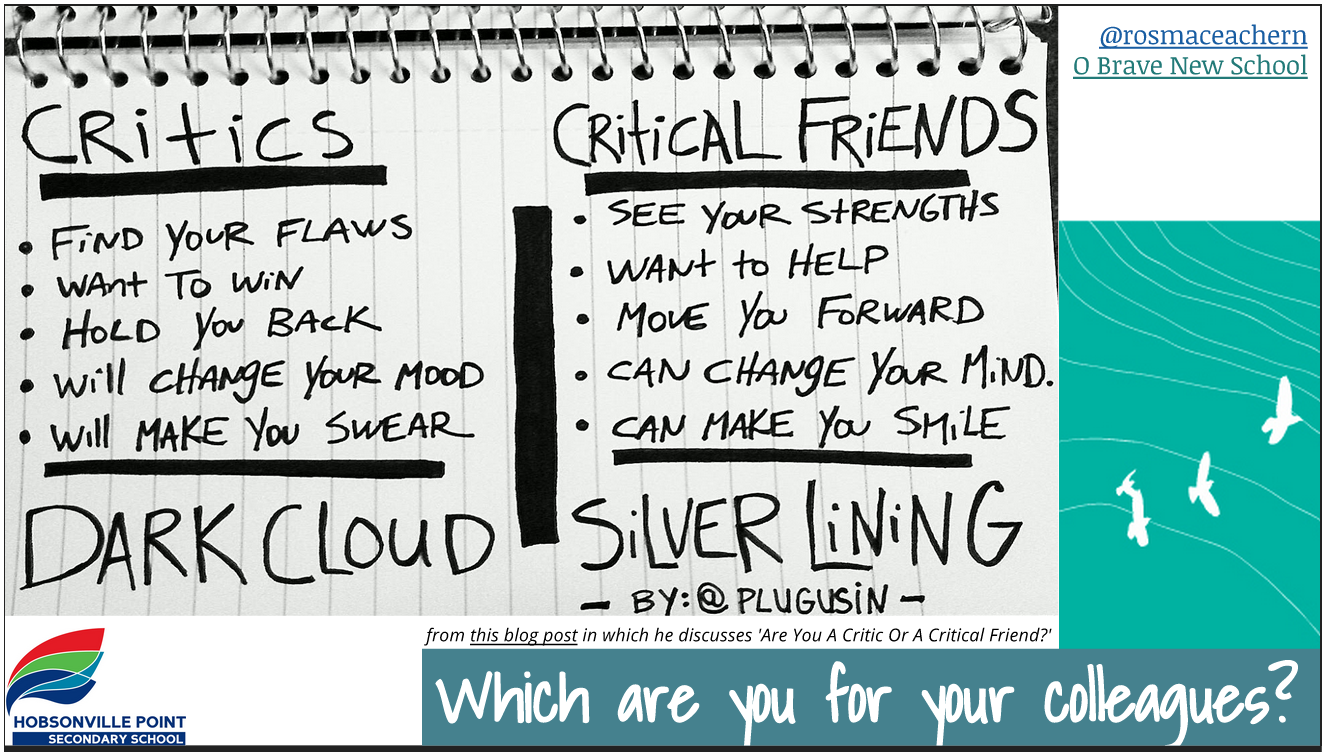
Critical friendships can help educators improve their own professional learning - rather than having learning done to us, peer learning puts us in the driver's seat. Critical friendships are an important part of the culture at Hobsonville Point Secondary School, Ros helped facilitate the formation of these friendships.
Putting the 'critical' into the relationship can be challenging. By having all teachers included in the design of the observations tool etc. all teachers feel ownership and are able to take part more effectively. The modelling of this form of ako to the students further affirms the philosophy of Hobsonville Point Secondary School. There are a number of schools around NZ that use this system effectively; it is helpful when such system is embedded across the school, supported by all and time is allowed for this to happen. MLEs and the approach of 'all students are our students' links in well with that for Roz and her colleagues. "It takes a village to raise a teacher" Mike Esterman - so true!
In preparation for next year and new staff coming on board, Roz is considering how she can involve the new staff into the design process so that they can own the process, too. Set up through Google Docs, it has been easy to change as it has been required so far, and changes will continue to be made to meet teacher needs.

My First Flipped EC Experience - Hannah Dodds
Hannah is a Y1 teacher in Western Australia. She calls herself a Newbie Coder and KAGAN enthusiast.
What does flipped learning look like with young learners? Hannah has adapted models she had seen to better meet the needs of her students, giving them some explicit teaching and then the opportunity to work individually. As a result, student engagement improved and their achievement increased. Hannah uses KAGAN, a model I have not been familiar with yet - you can find out more at http://kagan.nz/. While it was not without challenge for Hannah, by her empowering students to have choice, control and drive their learning, these students are more ready to face the future:)

What I particularly loved about this presentation is that Hannah is already thinking about how Critical Friendships, as described by Ros, could help her and her colleagues to further improve their practise!
#TMSydney - Matt Esterman
Matt is well known to many of us, not just for his work with TeachMeet Sydney, you will also find him on Twitter and many other Social media platforms.
TeachMeets are a great way for teachers to learn with and from each other. TMSydney has a lot of events with any number of participants - check out https://tmsydney.wikispaces.com/. There are no leaders at TeachMeet, just teachers who have done it before so please get involved!

There are a number of Ed Events coming up in New Zealand:
Ulearn 2015 7-9 October
Check out GEGNZ for their upcoming events
#edbookNZ - watch this space!
#EduCamp Kaikoura 7 November
#scichatNZ is every other Tuesday during term time, starting back on 13 October
# CENZ event Thurs Week 1
and in Australia:
#EdCampQLD 17 October at Noosa
#TMSydney have regular events across Sydney
Thanks for joining us, you can watch the full recording here on YouTube:
Clicking on the hyperlinked presentation titles above will take you to the individual presentations, and their recordings will be added over the coming weeks.
Thanks to the lovely +Marnel van der Spuy, here is the Twitter Storify:
As always, thanks heaps for organising +Sonya Van Schaijik and to the presenters and supporters for giving up their Saturday morning / afternoon!
This will be my first attempt at live blogging during the event, so please be patient with me:)
Our presenters are
+Fiona Grant on Being Cybersmart,
+Isaac Crandell-Tanner on Project Based Literacy Learning,
+Ros MacEachern on Critical Friendships,
+Hannah Dodds on her First Flipped EC Experience,
+Matthew Esterman on #TMSydney,
as usual hosted by the fabulous +Sonya Van Schaijik and +Rachel Chisnall as Twitter Broadcaster.

Being Cybersmart - Fiona Grant
Fiona is well known in NZ education and beyond for her work around EducampNZ, with GEG New Zealand and much more. She currently works as Facilitator for the Manaiakalani Trust, supporting teachers, leaders and schools to inquire into their practise to improve student outcomes.
Why do we need to be cybersmart? With the move to 1:1 to enable learners to be confident, connected and empower them to drive their learning, students are learning to become 'at home' in a digital world. It is really important that we teach our students about being smart when online. As blogging is integral to the programmes at Manaiakalani schools, students need to apply their cybersmarts all the time, not just at school, but for life. Fiona and her colleagues have found that it is vital to integrate cybersmart programmes into the curriculum and not just have it as a stand-alone programme to ensure that these skills get truly embedded.
While students are surrounded by devices more and more, students still need to be explicitly taught to be cybersmart. The emphasis is on being positive, to make good choices.


Project Based Literacy Learning - Isaac Crandell-Tanner
Isaac works at Hillcrest High school in Hamilton as English and Literacy Teacher for years 9 - 13.
Isaac has been working with a Y9 class to support them to increase their literacy skills to be prepared better as they are heading towards Y11. He reflected on his lesson designs and felt he could improve on that with a project-based approach to better engage his students and help them achieve. Using Google Docs, Isaac shared instructions and modelled what he was looking for.
Isaac found that giving students choices, providing teacher modelling and the fact they worked on authentic projects made a difference to the students' learning. A by-product of this project was developing more digital literacy skills in regards to the reliability of online courses etc.
He has identified some points that he could improve on in regards to monitoring etc. The big buzz for the students (and him) was when student letters were published in the paper, which gave them true authenticity.

Critical Friendships - Ros MacEachern
Ros joined the staff at Hobsonville Point Secondary School after 9 years at Bay of Island College (the first school I ever taught at, and I still hold fond memories of my time there). She is Learning Team Leader and Responsive Pedagogy Leader.
Critical friendships can help educators improve their own professional learning - rather than having learning done to us, peer learning puts us in the driver's seat. Critical friendships are an important part of the culture at Hobsonville Point Secondary School, Ros helped facilitate the formation of these friendships.
Putting the 'critical' into the relationship can be challenging. By having all teachers included in the design of the observations tool etc. all teachers feel ownership and are able to take part more effectively. The modelling of this form of ako to the students further affirms the philosophy of Hobsonville Point Secondary School. There are a number of schools around NZ that use this system effectively; it is helpful when such system is embedded across the school, supported by all and time is allowed for this to happen. MLEs and the approach of 'all students are our students' links in well with that for Roz and her colleagues. "It takes a village to raise a teacher" Mike Esterman - so true!
In preparation for next year and new staff coming on board, Roz is considering how she can involve the new staff into the design process so that they can own the process, too. Set up through Google Docs, it has been easy to change as it has been required so far, and changes will continue to be made to meet teacher needs.
My First Flipped EC Experience - Hannah Dodds
Hannah is a Y1 teacher in Western Australia. She calls herself a Newbie Coder and KAGAN enthusiast.
What does flipped learning look like with young learners? Hannah has adapted models she had seen to better meet the needs of her students, giving them some explicit teaching and then the opportunity to work individually. As a result, student engagement improved and their achievement increased. Hannah uses KAGAN, a model I have not been familiar with yet - you can find out more at http://kagan.nz/. While it was not without challenge for Hannah, by her empowering students to have choice, control and drive their learning, these students are more ready to face the future:)

#TMSydney - Matt Esterman
Matt is well known to many of us, not just for his work with TeachMeet Sydney, you will also find him on Twitter and many other Social media platforms.
TeachMeets are a great way for teachers to learn with and from each other. TMSydney has a lot of events with any number of participants - check out https://tmsydney.wikispaces.com/. There are no leaders at TeachMeet, just teachers who have done it before so please get involved!

There are a number of Ed Events coming up in New Zealand:
Ulearn 2015 7-9 October
Check out GEGNZ for their upcoming events
#edbookNZ - watch this space!
#EduCamp Kaikoura 7 November
#scichatNZ is every other Tuesday during term time, starting back on 13 October
# CENZ event Thurs Week 1
and in Australia:
#EdCampQLD 17 October at Noosa
#TMSydney have regular events across Sydney
Thanks for joining us, you can watch the full recording here on YouTube:
Clicking on the hyperlinked presentation titles above will take you to the individual presentations, and their recordings will be added over the coming weeks.
Thanks to the lovely +Marnel van der Spuy, here is the Twitter Storify:
As always, thanks heaps for organising +Sonya Van Schaijik and to the presenters and supporters for giving up their Saturday morning / afternoon!
Subscribe to:
Posts (Atom)