Monday, 24 February 2014

My successful schools of the future

(As always, this is my opinion and may not reflect the opinion of my employers. I am rambling on a bit here, but this is an accumulation of various thoughts that have been going on in my poor little head for the last little while :D)

I'm just listening to a TEDx Talk,When I grow up I want to be happy: One student's experience of hacking his education:
This brought me back to a thought that has been going around in my head for quite some time: If I had 'the power', what would the successful schools of the future look like?

I have to backtrace here a little, as for most of us, my opinions and thoughts are shaped by my background and experiences.
I grew up in Germany, in a semi-rural region in the state of Bavaria, which has in my opinion a very old fashioned school system: After 4 years at primary school, students are separated into three different streams of schools, based on their mid year grades in maths, German and social studies. The lowest stream, Hauptschule, will lead to an apprenticeship after completion of y9 (I believe there have been some changes since, I have not kept up to date really). The reality is that many German parents do not want their children to go down this path, it often is the school for children of immigrants. Then there is Realschule, which leads to white collar jobs; it has a slightly better 'reputation' as after completion of y10 a student has the opportunity to enter another school and complete y11&12. This was the type of school I had trained for. And then there is Gymnasium, the school that most parents want their children to go to, the only stream that leads to full university entrance and therefore the school that all future teachers come out of (and then during teacher training they have to learn about the type of school they will teach in). Anyway, much could be said about this, but that would be sidetracking.
After 4 years at university I cam to New Zealand and completed my Graduate Diploma in Teaching (Secondary) in Whangarei. Straight out of the course I started teaching in the Bay of Islands as music teacher and HoD Music. From there I went to another high school as HoD Music. Then life started to become a bit more 'interesting' and I worked in parent education in the Far North, in the homes of parents of 0 - 3y olds. Back to high school as music teacher briefly, a stint a Playcentre as supervisor, and then I spent just under 5 years as Liaison Teacher for The Correspondence School, visiting students in their homes or their places of study. I returned into the classroom for 15 months at an intermediate school, some time at MoE Special Education, and now I have been in the e-learning facilitator role for 13 months. It's not quite your ordinary run-of-the-mill teaching career (which does make it quite hard to fit into the 'mould' some times - let me know if you know of a mould that fits me once my contract finishes at the end of the year, will you?).
Having had these diverse experiences and lots and lots of contact with parents and times in homes, I believe that while the education system in general is working for some of our students, it isn't for some of the others, and even for the ones it does work for, we could make improvements. Just a disclaimer here: I have never worked in cities, always in the rural areas of the Far North, hence my opinion is solely based on this.

What is we truly thought of a village raising the children? And how big is our village?
An American psychologist I used to work with said to me once "there is no wonder we have such high teen suicide rates in NZ, you can't go anywhere where you don't meet anyone you know" - there truly is only 2 degrees of separation in New Zealand! I can attest to this, I have only been in New Zealand for coming up 17 years, and I can barely walk into any school in the north without meeting someone I know. So let's look at the size of 'my village':
I don't even live in a village, I'm a few km down the valley. Depending who I talk to, I will describe where I live differently - name of the township, name of the valley, I might say north of Kaikohe, inland from Kerikeri or an hour north of the last traffic lights in Whangarei (that is the truth!) - so all of that is part of 'my village' to a certain degree. My children attended a lovely little primary school about 17km from our home (due to our prior connections) where the majority of students busses in. So that town and the places their friends come from are part of  'my village', too. I shop in Kaikohe and in Kerikeri, so they are part of 'my village'. I work in schools 80km north west, 80 & 85km north east, 100km south west and 60km south east - so that makes the rest of Northland my extended village also.

So if I see for example Kaikohe and Kerikeri as part of my village, what can I do for the children there? I have to say the schools in our area are working extremely hard, and many are having great results. Using my magic wand, I would love to see that everyone in education joined my view in all of us looking after all children - many people probably do already. After all, they will all be our future community members, there is no "I won't buy from the supermarket you are working at because you went to the other school!". I am not sure if our system is set up for it, but I would love to eliminate any 'ours' and 'theirs' thinking, in a way of schools feeling another school is taking 'their' students away from them - I think this might apply more to secondary than primary schools, often in the news they are talking about the 'zones' of the city schools and how living in the zone for one school can be a lot more expensive than living in a different school's zone. If all school worked together, would there be a way to get out of this??
I wish all schools could sit down and work out together what their particular strength is that they can offer students, e.g. there might be a TKKM, a Christian School, a school offering vocational pathways, a school focussing on arts / drama / music, a school with focus on academia etc. If we could ensure that there was easy transition between schools, students wouldn't have to get locked into the one or the other at an early age (like in Germany) because just like Logan says in his TEDx talk, they don't know yet what they want to be - except happy!
A school wouldn't have to be jack-of-all-trades (in our rural areas, it can be so hard to get specialist teachers: Often enough if a foreign language is offered for example, it finishes when that teacher leaves). However, what if there is just one school in an area??? I like the idea of effectively linking in with distance / online learning (though at this point in time I don't think it's as good yet as working together with at least some f2f interaction), because bussing all around a district is a waste of time in my opinion (I spend way too much time in the car every week...). Also, your local teachers, knowing you and your community, could be able to support you in your village much better than someone who doesn't know your village.
Many schools are already looking at linking in to local knowledge and expertise and I think this is great, another example where the community is raising the children by sharing their knoweldege (and also learnign from and with the children).
Is this a silly idea? I would love to hear what you think about this!

Another of my thoughts is about truly valuing learning outside 9-3 and the school grounds. I am the first to admit how annoyed I used to get when my students were away for a day and missed out on the vital work in my class (honestly, in my early secondary teaching days I didn't really care what else they missed out on, never mind what they gained from being away! How sad is that!). I have taken my children to Germany for 5 weeks last year and they learnt more and different things than they would have learnt at school (and my oldest still came away with awesome grades in his Y9 Cambridge Checkpoint exams). There are various reasons why students are away - looking after little brothers and sisters does not rank very highly in my opinion, but there might be some really good points in that. Visiting dad in prison is another sadly common reason for being absent at one of the schools I used to work at - who am I to say that visiting dad is less important than my school work?? Going to a relative's tangi is important, more important than analysing a classical music score!
So if I acknowledge that experiences outside school during class time are important, how can I help my students to
a) not fall behind in school work
b) support / incorporate their learning from outside school?

With modern technologies, a) can be solved more easily than previously: I can create a site and post work / tasks on there, accessible anywhere, anytime. My students could create shared notes in a Google Doc about the content of a class, also shared with the student who was away. I could set up flipped lessons that get discussed in class and / or online, we could video and post what is going on in class. Students could use blogs to reflect on what they have learnt.

For b) I need to go back to what I have been thinking and blogging about a lot last year: Relationships. We need to have a relationship with our students to realise what is going on, why they are away. We need to foster an atmosphere where they dare tell someone / you that they have been away to visit dad in prison. Where they feel they are not being judged or blamed. What about giving students a voice in their learning and ask them about how what they are experiencing outside school is fitting in with school? Is school offering relevance to their life? 
Digital Technologies again can be a help: When we went to Germany, my boys wrote a blog (admittedly, it was a bit of a chore for me trying to get them to do it - except for the post about Legoland lol). Photographs, videos, written and spoken reflections. This will not be appropriate for all occasions, but for example in the case of an oversea's holiday, they pictures a student chooses to post can give the teacher an insight about what is important for them and can provided topic for discussion, reflections etc.

So what would my successful schools of the future look like (if I had 'the power'): They would
Look at all students in a village as their students and teach to their strengths so all students get a great education
Use an online platform for collaboration and creativity, create flipped and rewindable learning, synchronous and assynchronousMake strong connections with individuals and their experiences and skills both inside and out of schoolProvide relevant, targeted learning opportunities

Where did I put that magic wand??? What would your successful schools of the future look like??

Friday, 7 February 2014

Apple TV and Reflector App


Apple TV (ATV for short) is a little gadget made by apple which you connect to a (tv) screen. It has built in wifi-connectivity as well as a small number of apps such as iTunes, Flickr, YouTube etc - almost a mini computer. In schools it is most often used for its ability to mirror (almost) any apple device to the screen wirelessly. At approx. NZ$150 (plus cost of a HDMI cable) it is not the cheapest way to show what's on an iPad on a bigger screen, but it is quite versatile.

Alternatively, you can purchase an app (programme) for your computer, e.g. Reflector App. This programme costs US$12.99 and installs on your computer (Windows or Mac). When you run the programme, your iPad can mirror to the computer (which might be connected to a big screen). One big advantage of this over the ATV is that you can show multiple devices at one time. However, you have one computer tied up with running this.

Why use it?

  • To show students what to do to get to an app on the iPad / how to use an app on the iPad
  • To use your iPad with the class and everyone can see what is on the screen (e.g. Popplet app, or a website)
  • For ATV: To use one of the built-in apps like YouTube and show on the big screen without needing a dedicated computer connected to the screen.
  • To have students share their work on the iPad on the big screen. (Note: The person holding the iPad is in control of the mirroring).


Both solutions depend on reliable wifi, the iPads need to be connected to the same wifi as the ATV or the computer running the reflector app. 

How do I mirror my iPad?

On iOS7, swipe up from the bottom of your iPad screen. If your apple tv or your reflector app are running, you will see it in the middle. Tap it, then select the device you want to mirror to and enable mirroring.

A little tip: It pays to set up your apple tv with a distinct name (I called mine 'Monika's apple tv', but you might want to call it 'apple tv room 3' or similar) as in a school setting your apple tv range might overlap - and you don't want to have your puberty education video accidentally appear on the screen in the new entrants' room!

Troubleshooting:

You can't see your device appear when you swipe up on the iPad?

  • Ensure ATV or reflector app are turned on. (Note: When using the reflector app, the name of your computer will appear in the iPad menu).
  • Have you selected the device and mirroring on the iPad?
  • Are your iPad and the ATV / computer running the reflector app on the same wifi?
You are mirroring the image but can't hear the sound?

  • Ensure volume is turned up on the iPad and the ATV / laptop. Note: You might want to check if little hands have tutued with the headphone socket on the iPad.
  • Does your screen have a 'sound out'? E.g. some of the IWBs have a separate sound control behind or to the side of the board, but your ATV is sending video and sound to the projector only (via the HDMI cable). One work around we have trialled is connecting the 'sound out' on the projector with a 'sound in' on the soundbox - you have to remember to change your sound source. Alternatively you could purchase a little USB charged speaker set nd attach it to 'sound out' on the projector.
Your ATV is stuck on 'setting date and time'? (As a result of this only the icons Computers and Settings will show, no connection to iTunes possible. Mirroring will still work.)

  • Connect your ATV to a different network, e.g. your cellphone wifi hotspot. This should resolve the issue, set date and time automatically and restore all your missing app icons (YouTube, Flickr etc.). When you reconnect to your regular network, ATV should work fine.
Your mirroring and / or streaming of videos is lagging and / or drops off?

  • You need robust wireless for mirroring to be effective.
  • You can help this by connecting the ATV / computer with reflector app to the network with an ethernet cable therefore reducing pressure on the wifi. Check with your techie if they both run on the same network, e.g. if you have a student byod and a different staff network.
I hope you find this useful! Please feel free to add to this in the comments box, or email me and I will add it to the post!

Friday, 31 January 2014

Leaving Voice Comments to Google Docs via Kaizena


This post was prompted by Hazel Owen's post here. New technologies should make it much easier for all our students to access their learning effectively. Universal Design for Learning is one of the key terms I am trying to understand and apply: How can we design learning environments and learning aexperiences to meet the needs of all our learners? I have shared a presentation on Google Forms for UDL with colleagues before, but we can also adjust Google Docs to meet needs of some of our learners better.

If your students are writing text in Google Docs, you can leave written comments in Google Docs. Using an app like Kaizena, you can also leave voice comments. Why use it? Do you students find it hard / boring to read your comments? Would you like to give your comments some personal touches? Try this:

Installing Kaizena:
  • Go to My Drive, click on Create.
  • Select connect more apps at the bottom.
  • In the new window, type voice into the search bar. Choose Kaizena, then click on connect.
Using Kaizena:
  • Select the Google Doc you would like to leave a voice comment for.
  • Right click it (Command click on a Mac?). Select Open with, Kaizena.
  • The GDoc now opens within Kaizena (it has a dark side bar on the left and the fonts look a little different, but the GDoc remains the same in Google Drive)
  • Select who to send the comment to (within the side bar)
  • Highlight any area within the document and you get a little Menu with options:
         You can leave a voice comment, a written comment or attach some links / resources.

  • By clicking on the green button above the highlighted area, you can review your feedback or add some more. While you are recording, you can scroll through the document though it pays to tell the recipient that you are scrolling while recording because the voice comment itself is linked to the area you had highlighted.
  • When you are finished, select the button "Send Feedback to" in the left side bar. You get the choice of adding it to the GDoc as comment or emailing it.
  • The feedback will be visible under comments back in the Doc in Google Drive:

If you would like to hear my ramblings on above doc, you can find it here. Please feel free to share some ways of how you use Kaizena or another voice comment app :)

The challenges of virtual meetings

Some light humour (yet so true) for the weekend; anyone who, like me, takes part in many virtual meetings, will be able to relate to this! Thanks to Hazel Owen who found this video via Allanah King and shared it on Virtual Professional Development!


Thursday, 30 January 2014

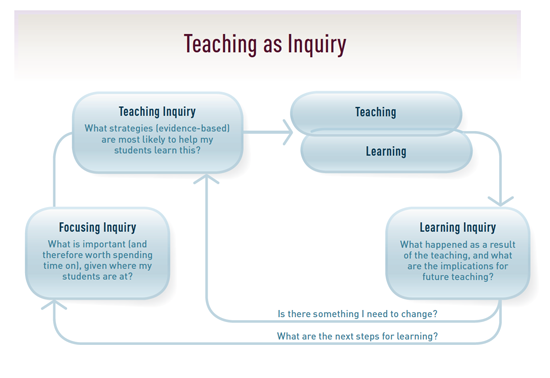
Teaching as Inquiry / Professional Inquiry

Teaching as Inquiry is not a new approach; it is part of effective pedagogy and describes the way good educators plan effective programmes for their learners. This diagram explains it a bit more, and for yet more information follow above link:
In our work with LwDT, our schools and the teacher at these schools apply the TaI process to their practise, asking themselves questions like "How can we use devices to support our students who are not achieving in writing yet?" etc. As facilitators we are asked to set ourselves inquiries relating to our practise also. I have decided that for this year I will make my inquiry very transparent and share my thoughts and findings on my blog. There are a number of reasons for this:
  • I can collate everything in one place
  • Putting it in writing and out there for anyone to see will make me think a lot harder about it
  • The possible audience might keep me on my toes to work on it more regularly.
  • My inquiring might inspire other educators to inquire into their practise also
  • While I wouldn't say that my way is the perfect way, at least it could model one way to other 'inquirers'.

My topic is Challenging Conversations. I am not a fan of challenging conversations, in fact I would much rather we all just got on with each other. But the reality is we don't, and while there are times when it is better to 'let something go', but when it is about students and their learning we should never let things go. There are a number of occassions in my professional life when I should have had a challening conversation with someone and didn't; it's about time that I did something about this.

At this point in time I am thinking about structuring my inquiry in 3 parts:
  • What are challenging conversations? How do they come about, why? How do we decide when to have a challening conversation and when to 'let it go'?
  • The conversation itself: When, how, what? How do we prepare ourselves for them - both the person leading and the person responding?
  • The 'aftermath': What happens after, in both positive and negative outcomes of that conversation?
We have had a fantastic session with Joan Dalton and David Anderson this month on Partnership - What it takes to work with others and I am looking forward to using some of the skills I have learnt and the resources they have mentioned as part of my inquiry this year.

I am looking forward to hearing from anyone about their inquiry or about their experience with challenging conversations!

MOOCs

Have you ever taken a MOOC - Massive Open Online Course? I have just enrolled into Coursera's Gamification MOOC. @kwerb - Kevin Werbach (Associate Professor of Legal Studies & Business Ethics The Wharton School, University of Pennsylvania) - has posted the first few video lectures. Being new to this, I am impressed by the presentation and by the quality of the videos (I'm still hoping for fast internet here one day!).
The syllabus sounds very interesting:

  1. What is Gamification? (Video Released: January 27th)
  2. Games (Video Released: February 3rd)
  3. Game Thinking (Video Released: February 10th)
  4. Game Elements (Video: February 17th)
  5. Psychology and Motivation I: Behaviorism (Video Released February 24th)
  6. Psychology and Motivation II: Beyond Behaviorism (Video Released February 24th)
  7. Gamification Design Framework (Video Released March 3rd)
  8. Design Choices (Video Released March 3rd)
  9. Enterprise Gamification (Video Released March 10th)
  10. Social Good and Behavior Change (Video Released March 10th)
  11. Critiques and Risks (Video Released March 17th)
  12. Beyond the Basics (Video Completed March 24th)


I am a little worried about the time limits for the quizzes and the final exam, fitting it all into my days, but I will try!!! If you are also interested in Gamification and want to give it a try (after all, it is a free course unless you want to sign up to Signature Track for US$49), you can still sign up, so come and join @madmacnz (Carol Kendall) and I!

Wednesday, 29 January 2014

Blogging Meme #5

If you have beenr eading my Blogging Meme posts, you must know me better than I know myself by now! I didn't know I was that popular ;) thanks to @melulater, here are my answers:

1) What is your favourite movie of all time?
I always loved "Milch und Schokolade", originally "Romuald et Juliette". There is just something about the love story between a rich, lovely yet very impractical and inconsiderate man and a very smart mum of five who cleans his offices, solves crimes and 'sorts him out' :) I don't think there is an English version.
2) Who was your favourite teacher as a child and why?
I often said I became a teacher because I didn't like school - and I wasn't an easy student though academically I did well. There are some I remember very fondly, especially my former flute teacher now friend Hanna :)
3) If you could combine any two animals in the world, which ones would you combine and why?
Just this morning I thoughthow much we humans are destroying in this world - I am really missing the bees for pollinating my veggie garden! So I think rather than creating new ones, I wish I could bring some of the extinct ones back!
4) If you won Lotto Powerball, what would be the first thing you would do after the money went into your bank account?
Ring the bank manager to pay off the mortgage! (so sensible...)
5) You're Prime Minister for the day - what one thing would you do?
One day is not enough to have a long lasting impact of course, but I think it would be great to listen to our young people for what their dreams, hopes, aspirations and ideas are.
6) Which food/meal from your childhood haunts you still today?
Soup! There are very few soups I like, and definitely not vegetable soup, tomatoe soup, potatoe soup {gag}. My mum also tried to make us eat liver which inevitably ended up dry as leather and stank the house out - but maybe my mind is playing tricks on me?
7) In all your travels, in New Zealand or overseas, your favourite place and why was....?
Warm places with lots of nature and with water: Rarotonga, Far North of New Zealand, Coromandel, wet tropics of Northern Queensland...
8) Which song or artist always puts you in your happy place?
I like unusual voices but despit my music teacher past I have a really poor memory for names of artists and songs, sorry!
9) If your house was on fire, what three items would you save if that was all you could take?
My kids and husband, everything else can be replaced!
10) As an educationalist, what was one of your most satisfying moments?
When Tane gave me a hug on his last day of Intermediate School :)
When I did reviews with my BeL schools at the end of last year and they had all made such great progress!
When one of my Correspondence School students wrote me a thank you note after we got him out of his funk and into Natcoll!
Everytime I see the little light bulb above someone's head! (oops, that's a few moments lol)
11) What do you look for in a leader at your school/education facility?
Building relationships. Listening skills. Vision. Collaboration. Creativity. Walk the talk. Sound pedagogy. Life-long learner. (if I think some more, the list will become longer and longer!)

Thanks Melanie, this has been fun!